
Medical and discharge reports: structure, template and example
How does medical dictation become a structured report? See the AI automation workflow in Unomed Flows, an adaptable template and a fictional example for medical and discharge reports.
Medical reports with AI automation: how Unomed Flows works
Unomed Flows prepares a structured report draft from medical dictation. AI organises the text; the configured workflow defines the template, transfer into the practice software and the version for the referring clinician. Clinical review and approval remain with you.
- 1
Start with medical dictation
Dictate the reason, findings, assessment and next steps. These details form the basis of the report.
- 2
AI prepares the structured draft
Flows organises the dictation into a report draft. You check diagnoses, assessment, medication and next steps and complete missing information.
- 3
Continue in the practice system after approval
For supported processes, the workflow specifies transfer into the practice software and a version for the referring clinician. Content and recipients are reviewed before transfer or sending.
See dictation and text review in Unomed
German-language example views from the Unomed product design in Figma: the dictation window and text review in a clinical-history summary flow on the right. They illustrate input and review; the report template and subsequent steps are configured for your practice.
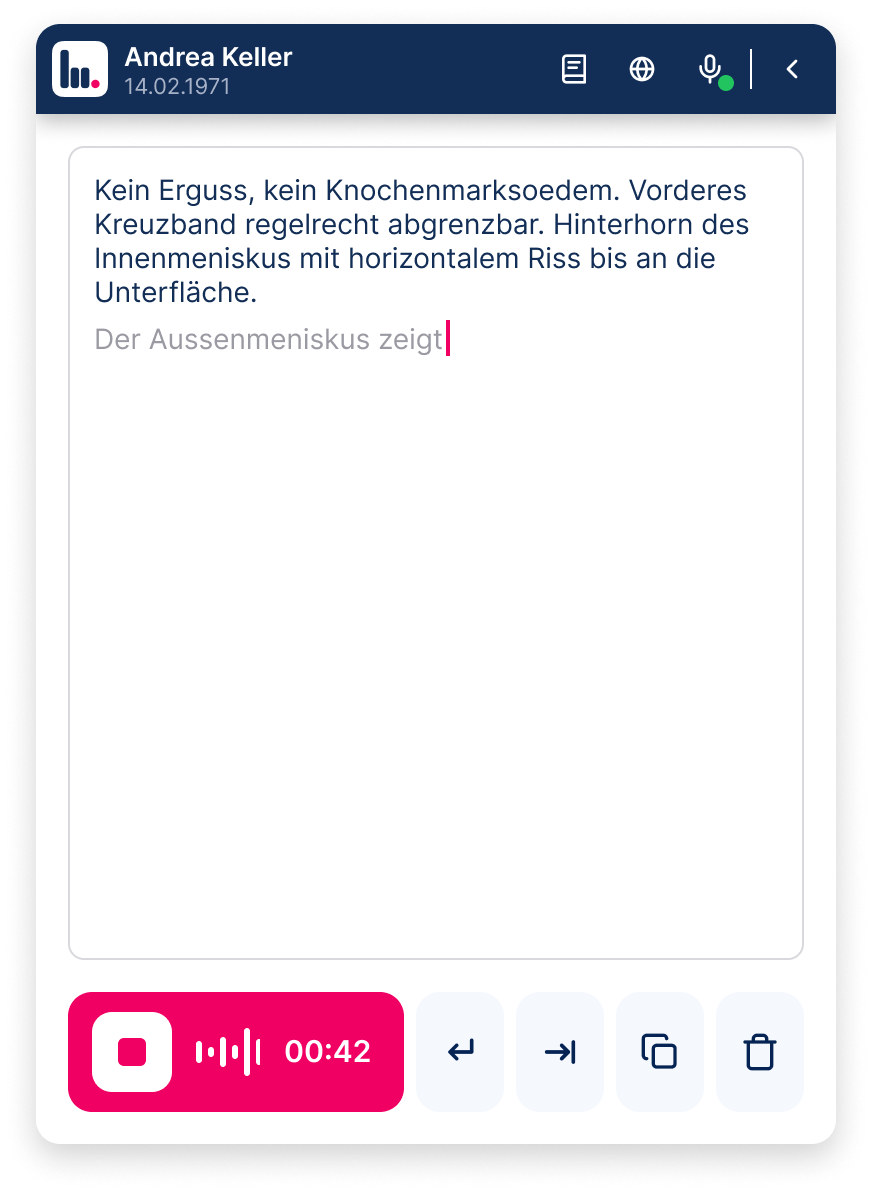
Dictation: Spoken text appears in the Unomed window and can be edited there. View from Figma.
Enlarge view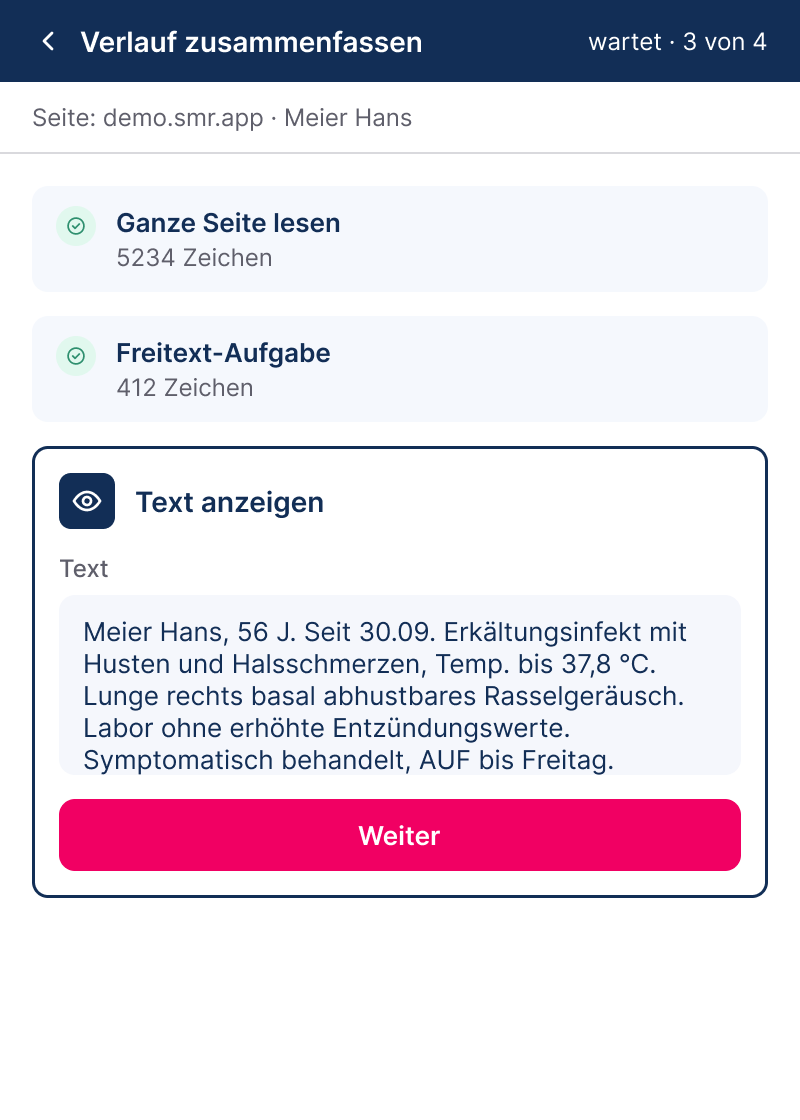
Text review: A flow displays the summary before you continue with “Weiter” (Continue). View from Figma.
Enlarge viewMedical report or discharge report?
Medical report is a broad term for a report on an examination, treatment or specific clinical question. A discharge report describes the transition from an inpatient stay to the clinician providing subsequent care.
The purpose determines what to include. A report to the general practice needs information for continuing care; a response to a referral also answers the original question. Adapt the outline below to the specialty, recipient and requirements of your organisation.
Medical report template: what to include
| Section | Information from the documentation |
|---|---|
| Header and recipient | Identify the patient, recipient, responsible clinician, report date and examination or treatment period. |
| Reason and question | Why was the examination or treatment requested? What question should the report answer? |
| History and findings | Present relevant information and findings. Distinguish the patient’s account from your own observations. |
| Diagnoses and assessment | Distinguish confirmed from suspected diagnoses. Explain the clinical assessment. |
| Treatment and course | Summarise documented measures and the relevant course. |
| Next steps | Record planned reviews, pending results, responsibilities and agreed next actions. |
| Approval and attachments | Check the responsible clinician, report status and related attachments. |
Use “not assessed” or “pending” when that describes the documented situation. “No allergies” is different from “allergy status unknown”. An empty template field does not establish a normal finding.
Additional information in a discharge report
The transition to continuing care must be understandable. Include admission and discharge dates, the condition at discharge and agreed next steps. Check current medication and changes, allergies or intolerances, relevant risks and pending results.
The IPAG recommendations hosted by eHealth Suisse address reports for transitions of care. They provide a structural reference here; this template is not presented as a certified electronic patient record exchange format.
Medical report example: a fictional short report
Follow-up discussion on 13 October. Symptoms unchanged according to the example person. Available examination results discussed. One result is pending. Discussion on 20 October at Example practice. Prepare the report as a draft.
Structured draft from the same information
| Section | Example text |
|---|---|
| Header | Example person A, fictional case DEMO-01. To: Example practice. Consultation and report: 13 October 2026. Status: Draft. |
| Reason | Follow-up discussion after a previously documented examination. |
| Patient account | The example person reports unchanged symptoms since the last appointment. |
| Findings and assessment | Available examination results were discussed. Individual findings and diagnoses are deliberately omitted in this short example. |
| Next steps | Discussion of a pending result is agreed. Responsible organisation: Example practice. Appointment: 20 October 2026. |
| Approval | Before sending, the responsible clinician completes and reviews findings, assessment and attachments. |
Discharge report example: make the transition explicit
For the same fictional person, the following additions illustrate a transition of care. Clinical information remains explicitly marked as placeholders. In a real report, it must come from reviewed records.
| Additional section | Fictional structure example |
|---|---|
| Stay | Example institution, 11–13 October 2026; draft for continuing care at Example practice. |
| Condition and course | [Enter reviewed findings, treatment, course and condition at discharge.] |
| Medication and allergies | [Enter reconciled discharge medication, changes and documented allergy status.] |
| Pending items | One examination result is pending. Example institution sends it to Example practice when available. |
| Continuing care | Discussion on 20 October 2026 at Example practice; complete findings and responsibilities before approval. |
Checklist before approval
- Do the report, source records and attachments refer to the correct person and period?
- Is the question answered? Are patient accounts, findings and clinical assessment clearly distinguished?
- Do diagnoses, medication, doses and allergy information match the reviewed documentation?
- Are pending results, next steps and responsible parties specified?
- Are recipient, attachments, report status and clinical approval correct? Is the intended sending channel used?
The free ICD-10 code search is available for additional diagnosis codes. Check that any selected code matches the documented diagnosis and applicable catalogue version. A code supplements the documentation; it does not replace it.
Sources for reports in Switzerland
FMH and SAMS explain care and transparency in medical reports. IPAG addresses information structures for transitions of care. These sources complement your organisation’s requirements; this article is an editorial working aid.